Recommended Books
Books to assist your entrepreneurial journey.
My Reading Path
Your saved books, picks, and what you're reading now.
Every book here connects directly to the business psychology explored in staging.courben.co articles, each one selected because it extends a specific psychological concept covered in our research. We only include books we genuinely believe are worth your time.
This page contains affiliate links. If you purchase through our links we may earn a small commission at no extra cost to you. We only recommend books we genuinely believe extend the psychology explored in our articles.

Say Good Night to Insomnia by Gregg Jacobs. Jacobs’s research-grounded account of the CBT-I programme developed at Harvard is the most directly applicable available treatment of the evidence for why the cognitive and behavioural patterns that maintain insomnia are the correct clinical target, and why the sleep disruption that the entrepreneurial context produces is both addressable and worth addressing as a primary mental health intervention rather than a secondary productivity concern. His account of the specific patterns, monitoring behaviour, compensatory strategies, and catastrophising cognitions that sustain insomnia once the original trigger has passed maps directly onto the Harvey cognitive model that the article covers, and his treatment of the CBT-I evidence base is accessible without clinical background while remaining grounded in the research. For the founder who wants to understand both why their sleep is disrupted and what the most evidence-supported available intervention for addressing it looks like, Jacobs provides the most research-grounded and practically oriented starting point.
Say Good Night to Insomnia by Gregg Jacobs. Jacobs’s research-grounded account of the CBT-I programme developed at Harvard is the most directly applicable available treatment of the evidence for why the cognitive and behavioural patterns that maintain insomnia are the correct clinical target, and why the sleep disruption that the entrepreneurial context produces is both addressable and worth addressing as a primary mental health intervention rather than a secondary productivity concern. His account of the specific patterns, monitoring behaviour, compensatory strategies, and catastrophising cognitions that sustain insomnia once the original trigger has passed maps directly onto the Harvey cognitive model that the article covers, and his treatment of the CBT-I evidence base is accessible without clinical background while remaining grounded in the research. For the founder who wants to understand both why their sleep is disrupted and what the most evidence-supported available intervention for addressing it looks like, Jacobs provides the most research-grounded and practically oriented starting point.
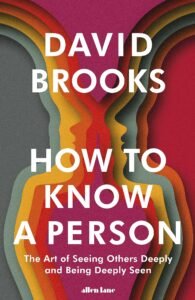
How to Know a Person: The Art of Seeing Others Deeply and Being Deeply Seen by David Brooks. Where King provides the network science account of social connection at the structural level, Brooks provides the interpersonal skill account of what genuine connection requires at the level of the individual interaction. His research-informed treatment of the specific attentional and conversational practices that allow one person to genuinely see another, and why the social contact that fills a founder’s calendar does not automatically provide the psychiatric protection that the research documents, gives the most directly applicable available account of what the difference between social contact and genuine connection actually consists of in practice. For the founder who wants to understand what they would need to do differently in their social interactions to access the protective factor that the psychiatric research identifies, Brooks provides the most practically grounded available starting point.

No Rules Rules: Netflix and the Culture of Reinvention by Reed Hastings and Erin Meyer. Where Scott provides the interpersonal communication account of how psychological safety is built in individual relationships, Hastings and Meyer provide the structural and cultural account of the conditions that make psychological safety sustainable at the organisational level. Their account of how radical transparency, high talent density, and explicit freedom from conventional corporate constraints create the environment where honest expression is both expected and safe, applied through Netflix’s commercial experience across two decades, provides the most directly available complement to Scott’s interpersonal framework: not just how safety is built between people but what the structural choices are that allow it to persist at scale. For the founder thinking about what kind of organisation they want to build and what the structural conditions of psychological safety require, Hastings and Meyer provide the most research-informed and commercially grounded available account.

Do Nothing: How to Break Away from Overworking, Overdoing, and Underliving by Celeste Headlee. Where Kahneman provides the cognitive science account of why extended hours degrade the quality of thinking, Headlee provides the historical, anthropological, and psychological account of how the assumption that more hours produces more output came to dominate working culture despite the evidence against it. Her research-grounded account of the Pencavel hours-output findings, the historical evidence for shorter productive working patterns across pre-industrial and non-Western cultures, and the psychological evidence that genuine recovery is not a productivity cost but a structural requirement of sustainable high output makes the complementary case from the outside in: not only does the cognitive science predict the diminishing returns, but the historical and cultural evidence shows that the working patterns now treated as normal are both recent and substantially evidence-free. Together, Kahneman and Headlee provide the cognitive mechanism and the cultural context for a research-grounded reassessment of the hours-output assumption.

Good to Go: What the Athlete in All of Us Can Learn from the Strange Science of Recovery by Christie Aschwanden. Aschwanden’s research-grounded account of what the sports science of recovery actually establishes, as opposed to what the culture around athletic performance claims, provides the most directly applicable available guide to the transferable and non-transferable principles of athletic recovery for a non-athletic audience. Her systematic examination of the evidence behind the most widely used athletic recovery methods, including ice baths, compression, nutrition timing, and sleep protocols, distinguishing what the research supports from what is placebo, sports mythology, or industry marketing, gives the entrepreneur the most honest available account of which athletic recovery principles are genuinely evidence-based and which can be discarded without performance cost. For the founder who wants to apply sports science to their working life without importing the entire athletic lifestyle, Aschwanden provides the most evidence-grounded available guide to what actually matters.
Good to Go: What the Athlete in All of Us Can Learn from the Strange Science of Recovery by Christie Aschwanden. Aschwanden’s research-grounded account of what the sports science of recovery actually establishes, as opposed to what the culture around athletic performance claims, provides the most directly applicable available guide to the transferable and non-transferable principles of athletic recovery for a non-athletic audience. Her systematic examination of the evidence behind the most widely used athletic recovery methods, including ice baths, compression, nutrition timing, and sleep protocols, distinguishing what the research supports from what is placebo, sports mythology, or industry marketing, gives the entrepreneur the most honest available account of which athletic recovery principles are genuinely evidence-based and which can be discarded without performance cost. For the founder who wants to apply sports science to their working life without importing the entire athletic lifestyle, Aschwanden provides the most evidence-grounded available guide to what actually matters.

Radical Acceptance: Embracing Your Life with the Heart of a Buddha by Tara Brach. Brach’s research-grounded account of the trance of unworthiness, the pervasive internal state in which the person experiences themselves as fundamentally not doing enough and therefore not being enough, provides the most psychologically precise available treatment of the internal condition that produces entrenched rest guilt. Her account of why the self-condemnation that produces the guilt cannot be resolved by arguing against it, why the rational knowledge that rest is productive does not touch the mechanism that generates the guilt, and what quality of attention to the internal experience actually allows the standard to loosen its grip, addresses the root mechanism of rest guilt rather than its symptoms. For the founder who knows they need to rest, who has read the performance research, and who still cannot rest without the guilt activation that makes the rest functionally unavailable, Brach’s account of the radical acceptance practice is the most directly applicable available resolution mechanism.

Supercommunicators: How to Unlock the Secret Language of Connection by Charles Duhigg. Duhigg’s research-grounded account of what distinguishes the conversations that produce genuine felt connection from those that merely transfer information provides the most practically applicable available account of connection as a learnable communicative skill. His analysis of the synchronisation mechanism — the process through which two people align their neurological states in conversation and produce the felt sense of genuine connection — maps directly onto the Gottman bid-for-connection research and the Siegel resonance circuit mechanism, and his account of the three conversation types and the specific practices that produce synchronisation within each provides the most concrete available guide to the social fitness skills the research identifies as most developable. For the founder who wants to understand precisely what they would practise differently if they were applying the social fitness framework to the conversations that constitute their relational life, Supercommunicators provides the most specific and most evidence-grounded answer available.
Supercommunicators: How to Unlock the Secret Language of Connection by Charles Duhigg. Duhigg’s research-grounded account of what distinguishes the conversations that produce genuine felt connection from those that merely transfer information provides the most practically applicable available account of connection as a learnable communicative skill. His analysis of the synchronisation mechanism — the process through which two people align their neurological states in conversation and produce the felt sense of genuine connection — maps directly onto the Gottman bid-for-connection research and the Siegel resonance circuit mechanism, and his account of the three conversation types and the specific practices that produce synchronisation within each provides the most concrete available guide to the social fitness skills the research identifies as most developable. For the founder who wants to understand precisely what they would practise differently if they were applying the social fitness framework to the conversations that constitute their relational life, Supercommunicators provides the most specific and most evidence-grounded answer available.

The CQ Difference: Unlock the Explosive Power of Cultural Intelligence by David Livermore. Livermore’s account of cultural intelligence is the most practically grounded research-grounded treatment of the four-component CQ framework and its developmental structure available outside the academic literature. Drawing on the Earley and Ang research tradition and on his own extensive work with organisations and entrepreneurs across cultural contexts, he covers each CQ component, the specific experiences and practices that build it, and the assessment tools through which the entrepreneur can identify their current CQ profile and the developmental investment that would address their specific gaps. For the entrepreneur who reads the Earley and Ang framework in academic form and wants the most practically actionable available account of how to actually build what the framework describes, The CQ Difference provides the most direct bridge between the research and the developmental practice it implies.

Managing Across Cultures by Susan C. Schneider and Jean-Louis Barsoux. Where McClelland covers the motivational foundations at the research level, Schneider and Barsoux cover the specific commercial management consequences of cultural differences — including the individualism-collectivism dimension — with a research base drawn from cross-national management studies and a practical orientation that makes the implications directly actionable. Their treatment of performance management systems, reward structures, team decision-making processes, and the specific cross-cultural management failures that cultural mismatches produce provides the most practically grounded available account of what the individualism-collectivism research means in the commercial management context the entrepreneur actually operates in. The combination of the motivational foundations (McClelland) and the commercial management applications (Schneider and Barsoux) covers the article’s mechanism at both the psychological and the organisational level.
Managing Across Cultures by Susan C. Schneider and Jean-Louis Barsoux. Where McClelland covers the motivational foundations at the research level, Schneider and Barsoux cover the specific commercial management consequences of cultural differences — including the individualism-collectivism dimension — with a research base drawn from cross-national management studies and a practical orientation that makes the implications directly actionable. Their treatment of performance management systems, reward structures, team decision-making processes, and the specific cross-cultural management failures that cultural mismatches produce provides the most practically grounded available account of what the individualism-collectivism research means in the commercial management context the entrepreneur actually operates in. The combination of the motivational foundations (McClelland) and the commercial management applications (Schneider and Barsoux) covers the article’s mechanism at both the psychological and the organisational level.

Spent: Sex, Evolution, and Consumer Behavior by Geoffrey Miller. Miller’s research-grounded account of the evolutionary and social psychology of consumer behaviour provides the deepest available theoretical foundation for understanding why price functions as a status and quality signal — and why the signal it sends varies so substantially across cultural contexts. Drawing on evolutionary psychology, signalling theory, and consumer behaviour research, Miller documents how humans use consumption to signal their attributes to others, why price is one of the most legible available signals, and how the social capital system within which status signals operate determines what a given price communicates. For the entrepreneur who wants to understand not just what cross-cultural pricing differences look like but why they exist at the level of the social psychology of status and display, Spent provides the most rigorous available account. The book’s account of conspicuous consumption as a signalling system — and of how that system operates differently in different social environments — is the theoretical foundation that makes the Veblen dynamic in high power distance markets, the relationship signal in high-context cultures, and the anchoring variation across reference price environments all predictable from a single underlying mechanism.

Dying for a Paycheck: How Modern Management Harms Employee Health and Company Performance — and What We Can Do About It by Jeffrey Pfeffer. Where Ericsson and Pool cover the individual performance biology of the effort-recovery oscillation, Pfeffer documents the organisational and cultural conditions that systematically produce the endurance pattern and its population-level health and performance consequences. Drawing directly on the allostatic load research, the Maslach burnout literature, and the epidemiology of work-related illness, Pfeffer shows that the workplace cultures that celebrate endurance and treat recovery as weakness are not producing higher performance; they are producing measurably worse health outcomes, higher turnover, lower sustained performance, and the specific biological consequences that McEwen’s allostatic load framework predicts. For the entrepreneur building a team as well as managing their own resilience, this is the most rigorously evidenced available account of what the endurance culture costs in biological and commercial terms, and why the structural conditions that enable genuine recovery are not a concession to softness but the organisational prerequisite for the sustained performance that commercial building requires.
Dying for a Paycheck: How Modern Management Harms Employee Health and Company Performance — and What We Can Do About It by Jeffrey Pfeffer. Where Ericsson and Pool cover the individual performance biology of the effort-recovery oscillation, Pfeffer documents the organisational and cultural conditions that systematically produce the endurance pattern and its population-level health and performance consequences. Drawing directly on the allostatic load research, the Maslach burnout literature, and the epidemiology of work-related illness, Pfeffer shows that the workplace cultures that celebrate endurance and treat recovery as weakness are not producing higher performance; they are producing measurably worse health outcomes, higher turnover, lower sustained performance, and the specific biological consequences that McEwen’s allostatic load framework predicts. For the entrepreneur building a team as well as managing their own resilience, this is the most rigorously evidenced available account of what the endurance culture costs in biological and commercial terms, and why the structural conditions that enable genuine recovery are not a concession to softness but the organisational prerequisite for the sustained performance that commercial building requires.

The Power of Full Engagement: Managing Energy, Not Time, Is the Key to High Performance and Personal Renewal by Jim Loehr & Tony Schwartz. Loehr and Schwartz’s research-grounded energy management framework is built directly on the effort-recovery model that Meijman and Mulder established: the fundamental unit of high performance is not time managed but energy oscillated — the deliberate alternation between expenditure and renewal that allows capacity to be built rather than merely depleted. The book documents what happens when recovery is treated as optional or as the passive absence of work rather than as an active and necessary biological process: performance degrades, emotional reactivity increases, decision quality falls, and the resilience capacity that commercial adversity requires is systematically reduced. For the entrepreneur who understands that commercial building is a sustained performance challenge rather than a sprint, Loehr and Schwartz’s argument is the most directly applicable available treatment of why recovery is not the interruption of high performance but its prerequisite. The specific chapters on sleep as a recovery modality, on the pre-sleep psychological wind-down, and on the compounding consequence of incomplete recovery translate the research mechanisms directly into commercial practice without diluting their scientific basis.

Upside: The New Science of Post-Traumatic Growth by Jim Rendon. Rendon’s research-grounded account of post-traumatic growth is built directly around Tedeschi and Calhoun’s foundational research and covers the full scope of what the PTG field has established: the five growth domains, the reconstruction mechanism, the deliberate rumination distinction, the social support conditions, and the crucial difference between genuine growth and the performance of positivity. Rendon interviews survivors of extreme adversity — cancer, violent crime, military combat, catastrophic loss — alongside the researchers who have studied them, producing a portrait of PTG that is both scientifically precise and humanly recognisable. For the entrepreneur who has experienced significant commercial adversity and wants to understand what the research says about what genuine development from that adversity requires, this is the most comprehensive and most accessible account available. The book is particularly strong on what PTG is not: the chapter on the distinction between genuine growth and positive illusion is the most rigorous available treatment of a distinction that entrepreneurial culture consistently fails to make.

Breath: The New Science of a Lost Art by James Nestor. Nestor’s research journalism, drawn from an extensive survey of the scientific literature on breathing mechanics and their physiological consequences, is the most accessible and most thoroughly research-grounded account available of why how we breathe determines as much about our autonomic state, cognitive function, and stress resilience as any other single variable under our direct control. Beginning with his own participation in a Stanford study on the effects of nasal versus mouth breathing, and extending through the historical, anthropological, and clinical research on breathing mechanics from multiple disciplines, Nestor builds the case that the extended exhalation breathing that Zaccaro’s research documents as directly activating the vagal brake is one instance of a much broader finding: the mechanics of breathing are the most direct available interface between the cognitive and the physiological, between the voluntary and the involuntary nervous system, and between the current moment and the autonomic state that determines how the current moment is experienced and processed. For the entrepreneur who is building a somatic resilience practice, Nestor’s book provides both the research foundation and the most practically usable account of what breathing practice is actually doing and why the specific mechanics matter.
Breath: The New Science of a Lost Art by James Nestor. Nestor’s research journalism, drawn from an extensive survey of the scientific literature on breathing mechanics and their physiological consequences, is the most accessible and most thoroughly research-grounded account available of why how we breathe determines as much about our autonomic state, cognitive function, and stress resilience as any other single variable under our direct control. Beginning with his own participation in a Stanford study on the effects of nasal versus mouth breathing, and extending through the historical, anthropological, and clinical research on breathing mechanics from multiple disciplines, Nestor builds the case that the extended exhalation breathing that Zaccaro’s research documents as directly activating the vagal brake is one instance of a much broader finding: the mechanics of breathing are the most direct available interface between the cognitive and the physiological, between the voluntary and the involuntary nervous system, and between the current moment and the autonomic state that determines how the current moment is experienced and processed. For the entrepreneur who is building a somatic resilience practice, Nestor’s book provides both the research foundation and the most practically usable account of what breathing practice is actually doing and why the specific mechanics matter.

Third Culture Kids: Growing Up Among Worlds by David C. Pollock and Ruth Van Reken. Pollock and Van Reken’s research is the most comprehensive available account of the psychological profile produced by a disrupted childhood — specifically the third culture kid experience, the most studied cohort of repeatedly displaced children, who grow up navigating cultures genuinely different from either of their parents’ home cultures. Drawing on decades of research, interviews, and clinical observation, they document the full profile in its complexity: the cognitive flexibility, the cross-cultural competence, the social intelligence built by repeated new environment entry, the belonging anxiety, the relational guardedness, and the specific adult professional expressions of all of these. For the entrepreneur who moved repeatedly as a child, Pollock and Van Reken’s research provides the most precise available framework for recognising the developmental installation — not as a deficit to overcome or a wound to heal, but as a specific psychological profile with specific advantages and specific costs, both of which are running in the commercial context whether or not they are examined. The belonging uncertainty that feels like a personal failing is a predictable developmental outcome; the adaptability that feels like a natural trait is a built skill. Understanding which is which is the beginning of working with the profile deliberately rather than being governed by its defaults.

Transitions: Making Sense of Life’s Changes by William Bridges. Bridges’s account of the psychology of major life transitions — developed from his clinical practice and grounded in the developmental and psychological research on how people navigate the endings and beginnings that significant life changes require — provides the most precise and practically applicable framework for understanding the identity disruption that leaving employment produces. His central distinction between change and transition is the most useful available conceptual tool for the person who has left employment and found that the practical change — the new business, the new daily structure — has not produced the internal clarity that was expected: change is the external event; transition is the internal psychological process, which proceeds at its own pace and requires its own work. His account of the ending phase — the specific psychological work of genuinely leaving behind the identity, the social belonging, and the criteria for self-evaluation that the old role provided — directly addresses the identity loss that the Tajfel and Turner mechanism predicts and that most discussions of entrepreneurship fail to acknowledge. For the person who left employment and finds the early entrepreneurial period harder than the practical challenges account for, Bridges’s framework names the experience with a clarity that makes the difficulty legible and the necessary internal work visible.
Transitions: Making Sense of Life’s Changes by William Bridges. Bridges’s account of the psychology of major life transitions — developed from his clinical practice and grounded in the developmental and psychological research on how people navigate the endings and beginnings that significant life changes require — provides the most precise and practically applicable framework for understanding the identity disruption that leaving employment produces. His central distinction between change and transition is the most useful available conceptual tool for the person who has left employment and found that the practical change — the new business, the new daily structure — has not produced the internal clarity that was expected: change is the external event; transition is the internal psychological process, which proceeds at its own pace and requires its own work. His account of the ending phase — the specific psychological work of genuinely leaving behind the identity, the social belonging, and the criteria for self-evaluation that the old role provided — directly addresses the identity loss that the Tajfel and Turner mechanism predicts and that most discussions of entrepreneurship fail to acknowledge. For the person who left employment and finds the early entrepreneurial period harder than the practical challenges account for, Bridges’s framework names the experience with a clarity that makes the difficulty legible and the necessary internal work visible.

It Didn’t Start with You: How Inherited Family Trauma Shapes Who We Are and How to End the Cycle by Mark Wolynn. Wolynn’s account of how unresolved parental fear, anxiety, and trauma transmit to children through behavioural modelling, relational attunement, and the unconscious replication of parental threat patterns provides the most directly applicable available treatment of the intergenerational anxiety transmission mechanism for a non-clinical readership. His central argument — that many of the fears, risk aversions, and worst-case elaborations that adults experience as their own have origins in parental or familial anxiety that preceded them — maps precisely onto the transmission research the brief covers, without the clinical framing that makes the academic literature less accessible. For the entrepreneur who has noticed that their risk tolerance, their response to uncertainty, or their pattern of elaborating threat in commercial situations feels disproportionate to the objective evidence but cannot be resolved through deliberate reasoning alone, Wolynn’s account of the transmission mechanism explains why the deliberate reasoning has limited traction: the threat model being applied is not the product of the entrepreneur’s rational assessment of their current commercial environment. It is inherited, operating below awareness, and calibrated to a situation that is not the situation the entrepreneur is currently in. His account of what identifying and updating the inherited pattern requires — the specific process of tracing a current fear response to its origin and deliberately examining its applicability to the current context — is the most practically specified available guide to the recalibration mechanism that Schore’s earned security research predicts.

Dreamland: Adventures in the Strange Science of Sleep by David K. Randall. Randall's science journalism account of sleep research covers the discovery of sleep stages and their functions, the architecture of a healthy night of sleep, and what disruption of each stage costs — providing the accessible narrative layer that gives the mechanisms described in this article their experiential texture. Read alongside Roenneberg's more technical chronobiology account, the combination provides both the biological timing architecture and the functional stage-by-stage account of what stress removes from sleep and why each removal matters. Randall's account of the researchers whose work established what sleep actually does is also the most readable available introduction to the science underlying Walker's more comprehensive synthesis.

The Founder's Mentality by Chris Zook and James Allen is the most rigorous available study of the decision patterns that distinguish founders who scale their businesses successfully from those who do not. Zook and Allen's research, conducted across hundreds of companies over more than a decade, identifies three specific attributes — the insurgent's clear sense of mission, the founder's personal ownership of the front line, and the bias toward action rather than process — and documents what happens to each as organisations grow and the founder's relationship to the business changes. Their account of the founder trap, where the founder's own capabilities and decision patterns become the primary constraint on the business they created, is the most empirically grounded available treatment of exactly the self-knowledge problem this article addresses. For the entrepreneur who wants to understand not just the general case for self-awareness but the specific ways in which the founder's self-model shapes organisational capability and limits, Zook and Allen provide the commercial data that the psychological research predicts but does not itself document.

Weapons of Math Destruction by Cathy O'Neil. O'Neil's account of how algorithmic systems and commercial design choices systematically exploit cognitive limitations and power asymmetries against the interests of the people they affect provides the most structurally grounded available complement to the dark patterns and autonomy preservation mechanisms. Her specific account of the conditions under which commercially motivated design becomes exploitative, and what structural transparency and accountability requirements would look like, maps directly onto the Sunstein transparency criterion and the exploitation versus enablement distinction this article identifies as the primary ethical tests.















































































































































































































No books found matching your search.